|

EL BURGO -
MAIN MONUMENTS
IRRIGATION
CHANNEL FOR THE WINDMILL
-
UP
This old medieval irrigation ditch brought
water to a flour mill, nowadays in ruins,
running along the riverbank of the River
Turón. From its source as far as the
village, it was known as the River of El
Burgo, but the name changes once its clear
water and luxuriant banks have gone past the
village. El Burgo cannot be imagined without
its river. The river has enabled it to be,
since ancient times, an agricultural
settlement where the only industry was that
moved by the force of water, the mills. In
present times it is provides drinking water.
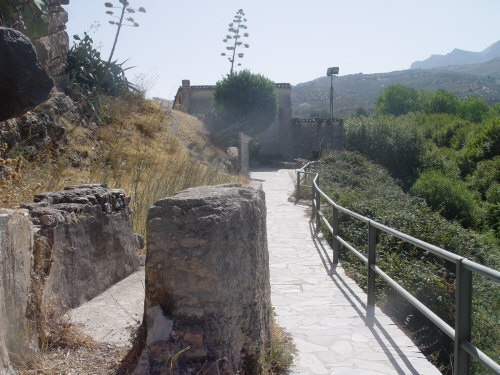
There are only a few remains of the course
of the former irrigation channel, which
carried water to the old medieval hydraulic
mill known then as the “Flour Factory”, and
more recently as “the Factory of Salvador”.
Three people used to work in this mill,
usually the poorest, who were given a daily
meal and some coins at the end of their
working day. The price fixed for milling the
wheat depended on the mill and the owners.
The miller retained 3 kg for each “fanega”
(1.5 bushels). They worked year round and
the wheat, flour and bran were transported
by pack-animals and muleteers.
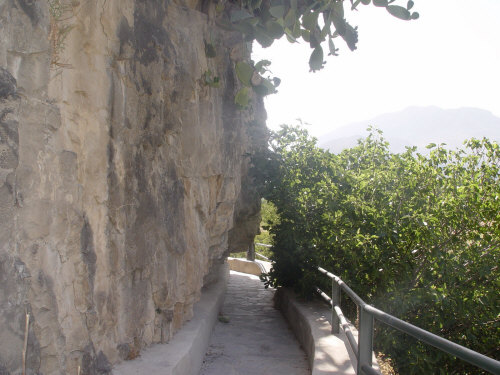
There were 4 flour mills in El Burgo. (Mill
of the Fuensanta, Mill of Salvador and two
more in Los Bujeos).
In order to tell if the flour was of good
quality, the miller of long ago, in the
course of his noble work, could know by the
smell alone if it was burning or if
everything was working well. If the flour
was “burnt”, the miller used a “pressure
control mechanism” which, by utilizing a
crank and nut, a chain was wound up which in
turn pulled a “board”. This mechanism
brought about the separation by a few
millimetres of the stones that grind the
wheat, making the friction lighter between
the stones.
Nowadays, it is all a fleeting memory; the
old mills, or what remains of them, leave us
thinking about their owners, the work and
the conversations between the muleteers who
came and went. A part of our history that
has disappeared, leaving us a memory of the
efforts of those men and women who, with
their bravery, contributed to the
development of a rural society.
HERMITAGE
OF SAN SEBASTIÁN
-
UP
The Hermitages are usually humble
constructions dedicated to the worship of a
specific saint and built on the outskirts of
the Arab fortress towns in the reconquered
areas. They were used for worship by the
Moslem converts and travelers, as the
Christians usually went to the Churches. The
“Moriscos”, converted Moslems who were
therefore not expelled from Spain, were
indoctrinated there, in case of the
possibility “that they were not converted in
their hearts”.
After being reconquered by the Catholic
Kings, El Burgo was repopulated by “old
Christians” to ensure the implantation of
the Christian faith in one of the last
strongholds of largely Moslem population. To
be classified as an “old Christian”, a
person had to have no Arab or Jewish blood
any later than their maternal or paternal
grandparents. The status of “old Christian”
permitted several privileges, meaning that,
in especially important circumstances, such
as the appointing of a Knight of the Order
of Santiago or of Calatrava, or the simple
fact of wanting to become a priest, the
files of “clean bloodline” would be
consulted, which was to check, through many
witnesses, that the person being
investigated was “clean of all lineage of
Moorish or Jewish blood”.
The Hermitage of San Sebastián (Saint
Sebastian) was built on the hill next to the
cemetery at the end of the XV century,
shortly after the conquest by the Catholic
Kings. It is a simple shrine that has been
much reformed, conserving its Gothic stone
portal. It was given this name in honour of
the devotion of Catholic Queen for this
Saint. In the XIX century it was the place
to where the villagers were summoned for
receiving news on important issues, after
hearing the continuous ringing of the bell.
Nowadays, almost in ruins, it conjures up
the memory of the efforts of the old and new
settlers in this wonderful land in their
desire to stay here.
IGLESIA DE SAN AGUSTIN
-
UP
The Church of San Agustín (Saint Augustin)
was built between 1950 and 1952 in Calle
Teniente Coronel Corrales, now renamed Calle
Enmedio.
The parish priest at the time, Vicente Pérez
Marañón, with the backup of the villagers,
decided to build the church on land that was
occupied by two houses, belonging
specifically to Mrs. Remedios Chicón and to
“the Crespos”, whilst the parish hall, the
patio and the “priest’s house” were built on
the site of an old oil mill that was no
longer profitable, facing the present Calle
Mesones.
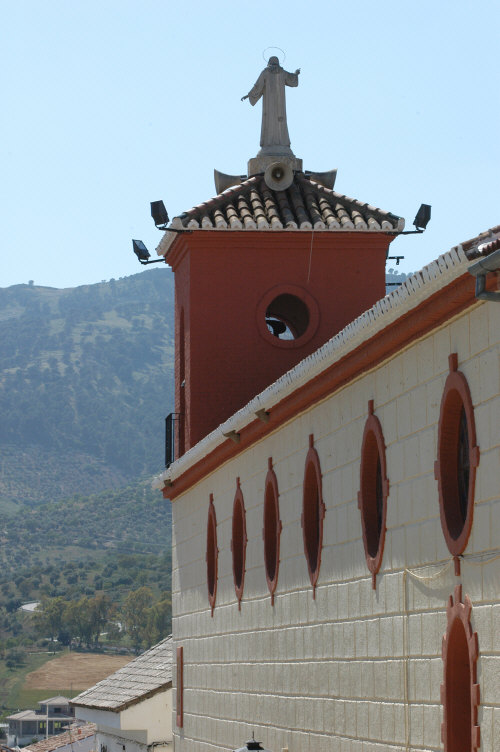
In the post-war period, funds were scarce,
logically, both on a provincial and a local
level, but the parish priest, determined to
go ahead with his project, on two occasions
asked Francisco Franco for the funds to do
so. With a little bit here and a little bit
there, plus other money given by Mrs.
Consuelo Pérez for the altarpiece and
donations from other villagers for the roof
of the church (from the wife of Don Bartolo)
and the contribution of the labour of most
of the local people, who brought sand from
the river and lime from the three limekilns
set up in Cancha de la Luna, the church was
erected.
The objective of this church was not to take
the place of the Church of the Encarnación,
situated in the village, but to bring the
liturgical ceremonies to the older villagers
who had more difficulties for walking the
distance up to the highest square of the
village.
The church was completely finished, but the
patio and the priest’s house were not. Two
12 year old boys were playing one day in the
patio when they found a small iron ball;
they went to play elsewhere, in Calle del
Porrillo, and there they pulled the ring:
one of the boys died and the other was badly
injured. Evidently it had remained there
since the Civil War. Ten years later, the
parish was inaugurated, specifically on the
27/04/1952, with a grand party and a
bullfight for the occasion.
Inside the church it is worth visiting the
altarpiece, the Heart of Jesus in the
belltower, San Agustin, the Virgin of
Fatima, San José and the Crucifixion.
The parish priests of this church, in
chronological order, have been: Mr Vicente
Pérez, Mr Mariano Porras, Mr Antonio Hoyos,
Mr Francisco García, Mr Salvador Benítez, Mr
Jesús Martinez and Mr Rafael Vivanco.
THE
Fuensanta AND THE WILLOWS
-
UP
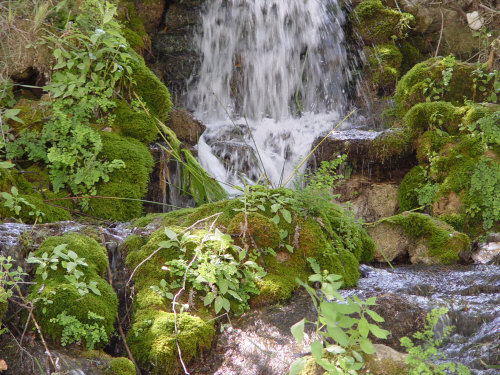
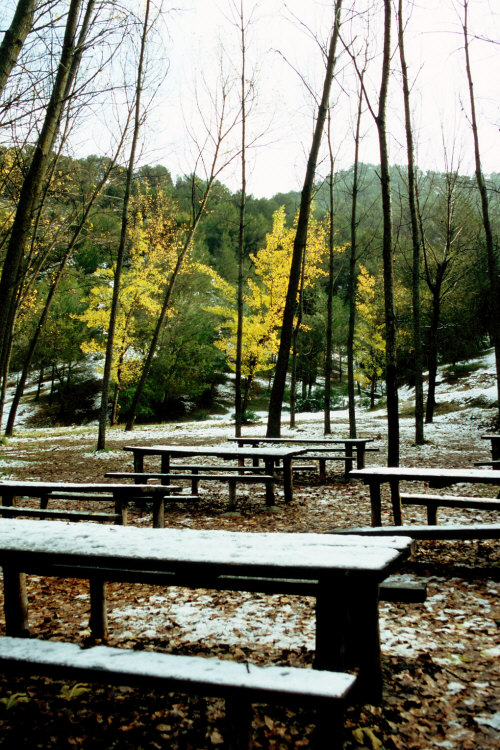
In the midst of wonderful scenery and in the
heart of the Nature Reserve of the Sierra de
las Nieves are two leisure areas that are
fully equipped for spending a beautiful day
in complete contact with nature. At the
Fuensanta, an old mill converted into a
refuge, the area is dominated by a poplar
grove in shade of which tables, barbecues,
toilets and plenty of water make it a very
pleasant place to spend the day. This is
where the villagers come to hold the
pilgrimage to the Virgin of the Snows.
Monument TO THE FOREST RANGER
-
UP
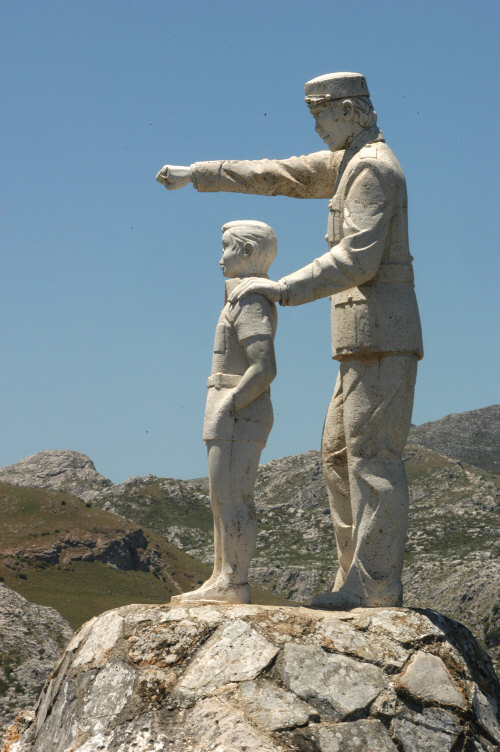
Situated in a spot with superb views over
the valley of the River Turón and the Sierra
de las Nieves, this look-out point is a stop
that is not to be missed on the road to
Ronda. To commemorate the first centenary of
the Forest Rangers, in 1977 the statue was
erected of a ranger showing a child the
beauty of this land, symbolizing the legacy
that we have the duty to leave to future
generations.
Pasos Largos
(LONGSTEPS)
-
UP
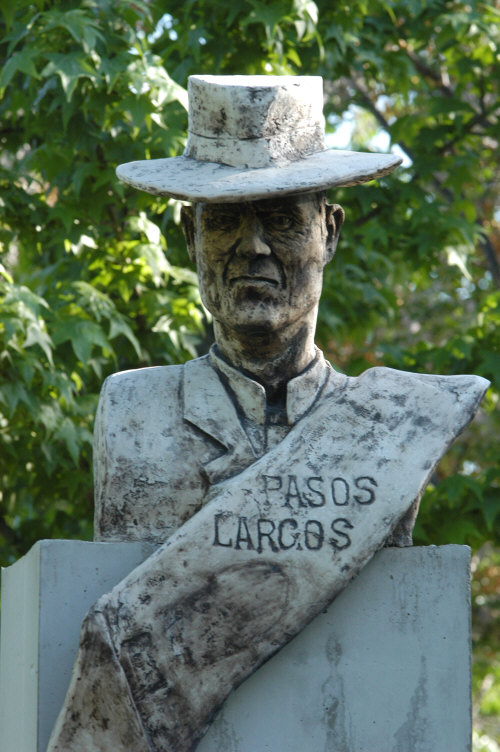
The chronicles record that
Juan José Mingolla Gallardo, known as Pasos
Largos (Longsteps), was the last of the
bandits of Andalusia. Juan was born in El
Burgo in 1873 and was the youngest of three
brothers, who worked a small patch of land
in the Pass of the Empedrados, whilst the
parents ran a small inn for muleteers in the
mountains of Ronda.
After the death of this father, he was sent
to Cuba, where he suffered the harsh
conditions of a colonial defeat. Upon his
return, he started a life of poaching and
was sought by the Civil Guard, whom he
managed to outwit, thanks to his intimate
knowledge of the mountains.
One day, in a fit of anger and vengeance, he
killed two members of the same family who
had reported him, and after wandering
through the mountains for months, he was
captured in 1916 and sentenced to life
imprisonment, first in Figueras and later in
Puerto de Santa Maria. Ill with
tuberculosis, he was pardoned by the
Republicans in 1932, after which he returned
to El Burgo, and started a new life as a
poacher in the mountains that had attracted
him since his childhood.
He was again arrested for poaching. After a
short term in the prison of Ronda, he
returned to the Sierra, stole a gun from the
farm of Lifa and his hate and anger at
everyone came back to him again; he started
stealing and was one again hunted by the
Civil Guard.
According to the narrative of García Blanco,
towards the end of his life, as his vision
was not so good, he used to hunt with traps.
On one occasion, a trapper who worked with
him betrayed him. His death in the cave of
Sopalmillo was a mystery, as officially he
died in a confrontation with the Civil
Guard, but other versions say it was the
result of a betrayal. What is certain is
that on the 17th March 1934, the last bandit
of the Sierra met his end.
ROMAN BRIDGE
-
UP
Although the oldest Roman bridges we know
about were made of wood, Roman engineers
demonstrated their skills in the
construction of stone bridges, such as this
one, known as the “Puente Málaga” the
“Malaga Bridge”).
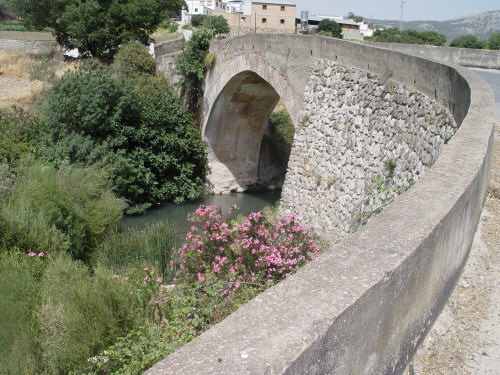
It was designed as a rounded arch, resting
on a row of columns. On top of this arch
construction was a road that crossed the
river. The bridge was built starting from
the foundations, once the firmest ground had
been chosen and the resistance of the
subsoil had been checked. The most serious
problem was that posed by the water of the
River Turón. To solve this, they used
caissons (watertight cylinders), inside of
which the building of the piers would be
started. The stonemasons built them up as
far as the level of the imposts, protruding
ledges that marked the beginning of the
arch. They would then stand aside for the
carpenters to place the formwork, the
boarding that would support the construction
of the arch and would be removed once it was
completed. The arch was formed on top of the
formwork, with voussoirs being placed at
intervals until the arch was finished, Once
completed, the road surface was then laid,
the spandrels constructed, the parapets
built up for the safety of people crossing
the bridge, and it was blessed by the
pontiff. This bridge was, and is, essential,
as it was the crossing point from Iluro
(Álora) to Arunda (Ronda), which was one of
the main Roman Roads in the Province of
Málaga, connecting Málaga with the interior,
and more specifically with the Via Augusta.
Thanks to reconstruction, during the XVII,
XVIII and the last quarter of the XX
century, of this bridge of Roman origin, it
is possible to still cross the River Turón
to get to Málaga, just like the Roman army,
the patricians, the plebeians and slaves of
ancient times, and have access to the rest
of Baetica.
|